
Receive a presentation of services and expert advice
The best experts in the industry will oversee your brand development process.
→ Need branding, design, or creative solutions? Call us at +48 505 648 022 or message us on WhatsApp.
 WeLoveBrands.pptx

The best experts in the industry will oversee your brand development process.
In today's highly competitive air travel market, companies must compete for every customer. Positioning plays a crucial role in this regard. Brand identity elements are powerful arguments in the battle for customer loyalty. The logo, name, and other details not only help identify the aircraft and airline but also create associations with the carrier's values and ideas.
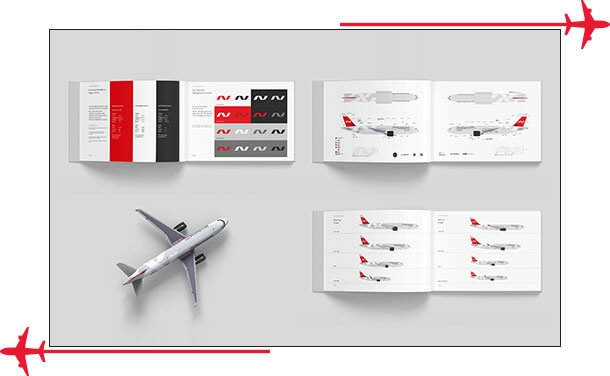
Creating a corporate identity involves many details. A brand must unite otherwise unrelated elements and instill a sense of security.
When purchasing airline tickets, passengers consider reliability, comfort, and punctuality, so corporate identity should reflect these principles.
 |
needs and expectations of the target audience; |
 |
distinctive features of the airline from its competitors; |
 |
geographical features (regions in which the airline operates); |
 |
direction of activity (freight or passenger transportation); |
 |
ethnic and national characteristics. |
A name should be easy to pronounce and remember . Most often, airline names use associations with lofty ideals, words like "avia," "air," and mention regions ( American Airlines , Lufthansa, Northwest, United Airlines, Wizzair). But other names also exist, such as " Blue Islands," "EasyJet," and "Arkefly."
A slogan should be short, memorable, and convey the company's message . For example, "Expand Your World" (Turkish Airlines), "Hello Tomorrow," and "Fly Better" (Emirates).
A logo reflects the quality of service, aesthetics, and advantages of the airline. The symbol should be simple and easily legible on any surface.
Color scheme . Well-chosen shades inspire trust and create a positive mood. Blue, red, and yellow are the most commonly used colors. Blue is associated with reliability, red with caring, and yellow with optimism and happiness.
Corporate fonts define an airline's style and identity. They are essential for recognition and distinguish the carrier from competitors. Exclusive fonts convey a company's reliability, stability, and success.
Employee uniform design . The way flight attendants dress is of paramount importance. Uniforms help create the company's image and communicate the airline's ethos.
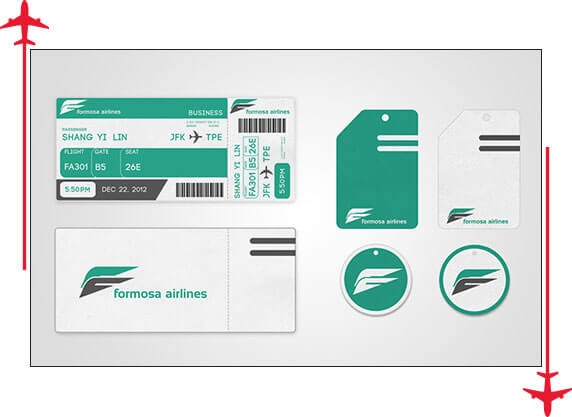
Identity on souvenirs and documentation . Applying the airline's identity to various items is an additional way to promote and create a positive impression of the airline. It is an important part of the airline's individual image.
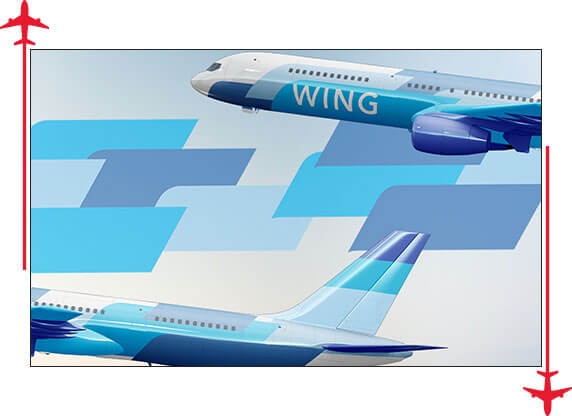
Airplane livery . To passengers, all planes look alike. A livery (either on the fuselage or the tail) can help make a plane stand out. The design should be bright and unique. Most often, the airline's name and logo are included, along with a distinctive tail.
 |
Pricing policy. Low ticket prices attract a large number of customers, so this factor can form the basis for developing a corporate identity for budget airlines. If the price is high, it needs to be explained (additional onboard services, daily flights, etc.). Effective branding can help with this. |
 |
Classification. When creating a corporate identity, consider the type of company being considered. Will it be scheduled or charter flights, multi-level aircraft or a restaurant, business or economy class. |
 |
In-flight services. These may include: in-flight meals (basic or deluxe), alcoholic beverages, the ability to carry on more items, etc. |
 |
Quality of service . Economy class passengers may be served by several flight attendants, and VIP passengers may be offered special treatments (massages, personal chefs, etc.). |
Developing a corporate identity is a labor-intensive and creative process. While on a plane, a person pays attention to many things, so every detail must be carefully considered – from the tickets to the in-flight tableware and the aircraft's livery.
Collection and analysis of information about the target audience and competitors.
Identifying the needs and desires of consumers.
Creating a company concept, defining its mission and values.
Implementation of key airline positioning elements. For example, displaying service levels (business or economy class), modes of transport (passenger or cargo), routes (domestic or international), etc., in the corporate identity.
To create a successful and prestigious brand, you need to find your own distinctive features and deliver on your promises. Customer expectations must be fully met, otherwise, the company's image will begin to deteriorate, and sales will decline.
 |
creative approach and modern solutions; |
 |
vision of the future; |
 |
display of confidence and competence; |
 |
ethical standards (respect for employees, passengers and partners); |
 |
high level of service. |
Advertising plays a vital role in brand building. Creative and innovative ideas can help increase airline recognition and increase loyal customer base.
Pacific Airlines – season of discounts on flights.
Student Flights – “Fly to Australia for the price of 372 cans of beer.”
El Al – “Sleep in Tel Aviv, wake up in India.”
A brand defines a company's lifestyle and direction. Branding helps improve an airline's operations and increase its value.
Looking to create a unique corporate identity for your airline or undertake a rebranding project? Contact WeLoveBrands. For a consultation or to place an order, please fill out the form on our website or call us.