Receive a presentation of services and expert advice
The best people in the industry oversee your brand development process
→ Need branding, design, or creative solutions? Call us at +48 505 648 022 or message us on WhatsApp.
 WeLoveBrands.pptx

The best people in the industry oversee your brand development process
There are over half a million well-known brands worldwide, and their number is constantly growing. Companies strive for recognition and invest in personal branding, considering it a vital factor in business development.
WeLoveBrands experts explain why a personal brand is so important and how to increase your business's marketability by promoting your own accounts. Learn how to create a positive impression online, what mistakes will ruin all your promotional efforts, and why it's worth using archetypes in branding.
"Style" refers to a set of visual decisions that create a recognizable image. These are the characteristics and outward manifestations of a person's individuality.Imageis a broader concept. It is the complex impression we form on others through a combination of appearance and emotional impact.Styleis our external attributes; image is our social role.
A personalbrandcan be defined as a combination of image, professional qualities, expectations, and promises that arise in people's minds when they hear a specific person's name.Personal branding, in turn, is an ongoing effort aimed at creating public perception and positioning oneself as an expert and authority in one's industry.
Building a personal brand is part of a marketing program for business development and building a lasting connection with target customers. Why do even famous owners of renowned companies work to develop andpromotetheir personal brands? Personal branding:
# 1 Increases trust in the company . The company owner's fame and popularity, as well as their personal and professional qualities, contribute to increased trust in the organization. Trust in the owner is transferred to the products and services. Conversely, a negative attitude toward the company owner can be transferred to the products or services, sometimes leading to disastrous consequences for the business.
# 2 Promotes market capitalization growth . It's hard to say how much well-known companies would be worth if they weren't backed by bright, charismatic owners with strong personal brands. Some examples have become academic: successful statements and actions by company owners lead to a surge in their share price.
# 3 Increases sales . People buy not products, but values and emotions. People trust personal brands, not companies. They buy from those they trust.

# 4 Stimulates interest in business projects . The owner of a well-known company establishes themselves on social media and in the media, becoming recognizable and influential. The company's business projects attract attention, making it much easier to attract funding for such projects.
# 5 Attracts qualified personnel . The image of a reliable employer facilitates the influx of valuable employees. Furthermore, the time and cost of recruiting staff are reduced, as business owners can find "those" people even from their personal Instagram Stories.
# 6 Helps in crisis situations . Well-known company owners can count on the support of society and the media. Publicity provides protection against risks, helps counter corporate raids, and challenges unjustified fines and sanctions.
When is it especially important for a company owner to develop a personal brand? This applies to those who want to be recognized, plan to significantly expand the business, enter new markets, promote new products and services, especially in the premium and luxury price segments, or are preparing the company for sale.
The psychological mechanismsfor formingfirst impressions online are the same as in real life: we ask ourselves whether we can trust a person, what their competence and usefulness are.
We subconsciously try to read and decipher hidden signals. Researchers call this phenomenon "thin-slicing behavior." They show that observations lasting less than five minutes and longer than five minutes yield little change. Initial impressions shape and reinforce conclusions about a person's personality. Online, these generalized conclusions are based on photographs, headlines, and the content of websites or social media profiles. Let's examine each point in more detail.
This is a key element of a first impression. According to various studies, people perceive 60 to 80% of information visually. People will evaluate photos before examining experience, qualifications, and other information. Quality and appropriateness are crucial for photos. The best Tinder profile picture won't necessarily be appropriate for LinkedIn. However, business websites often feature photos from parties. Photos should convey the image of a competent professional, reflecting their occupation and career achievements.
The setting in which a photo is taken significantly influences how people view us. In a professional profile, even a photo with something as innocuous as a glass of liquor can make someone appear less trustworthy.
Standing up straight rather than slouching, openly rather than with your arms crossed, and holding your head upright is always more authoritative. Be mindful of your body language—it can convey a lot about your reaction and attitude.
Formal or casual, dark or light clothing, neat or tousled hair—everything influences perception. Style should match the role you want to emphasize.
Looking straight ahead means being more memorable and inspiring trust. Sunglasses in photos are a negative, as they suggest secrecy.

A brand is the values a company or individual conveys to consumers. In personal branding, it's not the product or service that's being sold, but knowledge, expertise, and experience. Brands create associations and inspire confidence in the values they convey. Thus, a brand, through its external attributes, creates expectations in the audience.
Brand development can be divided into the creation of external attributes, which help build associations, and internal attributes—the brand's values, philosophy, and character. A positioning strategy is developed based on these internal attributes.
Archetypes are universal images that inspire a person to feel or think a certain way. Companies often create characters that align with consumer values and expectations. For example, Coca-Cola's Santa Claus evokes a festive atmosphere and family gatherings. Archetypes work similarly in personal branding. An archetype should not only meet audience expectations but also align with your style, personality, and beliefs.
There are many archetypes and their classifications. Emily Bennett, a marketer at the advertising agency Arnold Worldwide, proposed dividing the 12 main archetypes into four groups:
Archetypes of Order : "Ruler," "Caring," and "Creator." The main characteristics of this group's archetypes are honesty, a desire for security, order, consistency, and adherence to tradition.
Archetypes of belonging and connection with society : "Lover," "Jester," "Good Guy." These archetypes are characteristic of highly socialized people, active, open businessmen.
Archetypes associated with the desire to leave a mark on the world include the Rebel, the Hero, and the Magician. These archetypes are characterized by a will to win and achieve, while the Rebel is driven by a desire for change and even destruction.
Archetypes of Knowledge and Creativity : "The Innocent," "The Seeker," and "The Sage." According to Emily Bennett, this group of archetypes is characterized by individualism, independence, spiritual growth, creativity, and curiosity.
In a business owner's personal branding, the characteristic attributes are the "Ruler"—an organizer and manager—and the "Creator," who strives to generate and implement their ideas. People also trust the "Caring" and "Nice Guy" archetypes. The "Sage" and "Explorer" archetypes are good for the personal brands of innovative company owners. The specialists at WeLoveBrands will help you create a strong personal brand based on the right archetypes.

A sound personal branding strategy helps business owners achieve their goals and objectives. However, even minor mistakes can damage an impeccable reputation. Personal branding experts identify the following common mistakes:
Lack of strategy .Many entrepreneurs begin filling their profiles with content without developing a personal branding strategy.Brand development begins with self-assessment and asking questions: What am I an expert in? What is my unique value proposition? What useful thing can I offer? What is important to me? What is my primary motivation? And so on.
Discussing controversial topics .Discussing controversial issues such as religion or politics online is inappropriate, as they can cause disagreement or controversy, especially if the company owner is not involved in one of these areas.
Ignoring the storytelling genre .People love stories, and storytelling remains one of the few genres that hasn't yet become boring to users. Tell us how you founded your business, recruited your team, and what challenges you faced.
Failure to define personal values .A vague understanding of one's values leads to contradictions. A personal brand is about authenticity and consistency. Actions and words must be consistent with stated personal and corporate values.
Publishing other people's content .To become an expert, you need to establish yourself in your industry.Developinga personal brand involves publishing original content that demonstrates your expertise, experience, and value.
Excessive publicity .Personal information, life views, and professional ethics are all carefully scrutinized by potential investors and partners. Filter the content you plan to publish and avoid exposing too much to the public.
Self-obsession . Communicating in an "I" rather than a "you" manner is one way to alienate your target audience or potential partners.
Are there ways to avoid mistakes in building a personal brand? Yes, you can spend time studying the theory and try to navigate all the dangers and pitfalls yourself—or turn to specialists to save time and avoid failure.
What should you read to improve your personal branding skills? We've compiled a selection of books from the experts at WeLoveBrands.
In a rapidly changing world, entrepreneurs need a personal brand in addition to their company brand. This book by branding and marketing expert and bestselling author Donna Rachelson offers practical advice, real-life examples, and success stories to help entrepreneurs create and promote their personal brand. The author explains what a personal brand is, why it's important for your success, and what you need to do to develop and promote it. The book also features personal stories from seven entrepreneurs across various industries.
The book "Reinventing You" explains how to advance faster within your current company, successfully change jobs, or master a new field. This step-by-step guide will help you assess your unique strengths and becomea brandthat communicates value. Branding expert Dorie Clark combines personal stories with engaging interviews and examples from the careers of Mark Zuckerberg, Al Gore, Seth Godin, and other business leaders.
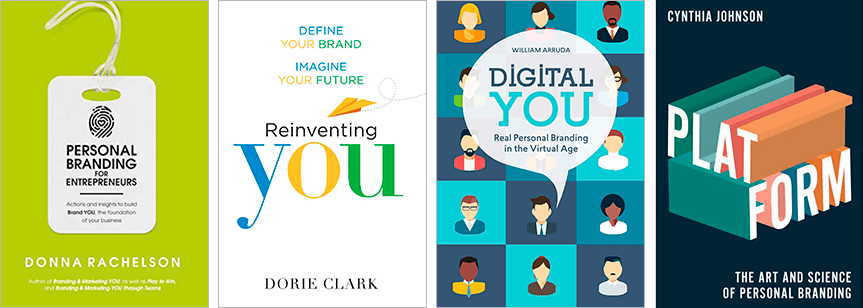
The most successful brands aren't created—they're revealed. How do you do that? In "Digital You: Real Personal Branding in the Virtual Age," branding expert William Arruda helps you manifest and expand your personal brand in the virtual world. Arruda explains that branding isn't just about being known, it's about selective awareness. Once you understand the true value of personal branding, you can use it as a serious career development strategy. This book will teach you how to form first impressions, craft a unique promise, and define your core values.
In today's world, influence is everything, and personal branding is influence. "Platform: The Art and Science of Personal Branding" is a practical guide for anyone looking to develop and manage their personal brand. In this book, digital marketing expert Johnson explains the process of going from unknown to influential. In just three years, the author went from a full-time social media manager to an influential entrepreneur and marketing leader, using her own method for accelerated brand development and ongoing management.
Even an established business owner in today's world needs a personal brand if they want to expand their reach, increase their income and asset value, become famous, and achieve recognition and respect.
You can create a personal brand yourself. Keep in mind that this requires specialized knowledge and preparation, and takes a significant amount of time and energy. Furthermore, creating and promoting a personal brand on your own doesn't guarantee the expected results and is not without risk of error.
The process of creating a personal brand in a specialized agency includes the following stages:
Setting goals. You need to answer the question: what are your goals?
Conducting an audit: what you already have and how it meets your goals.
Determining the budget for development and promotion.
Study of the target audience.
Defining a mission and finding unique personal qualities.
Development of a visual image.
Formulating a brand development strategy.
Selection of channels of interaction with the target audience.
Creation of unique content.
Trust the creation and promotion of your personal brand to the specialists at WeLoveBrands! For a free consultation , contact us by phone or via the website chat. Increase your visibility and grow your business!