Receive a presentation of services and expert advice
The best experts in the industry will oversee your brand development process.
→ Need branding, design, or creative solutions? Call us at +48 505 648 022 or message us on WhatsApp.
 WeLoveBrands.pptx

The best experts in the industry will oversee your brand development process.
Some people find the combination of separate, unrelated elements in a single object or composition intriguing, while others, on the contrary, find it difficult to comprehend. If you fall into the first group, then the style known as "Dada" will likely not go unnoticed. What this little-known avant-garde movement in the visual arts represents is what we'll discuss below.
The Dada style is one of the artistic trends of the European avant-garde. It cannot be strictly defined, as this would contradict its very essence.
According to the founders of this style, Dada has different meanings in different languages, but it is always something meaningless. Dadaism can be described with words such as absurdity, chaos, irony, and avant-garde.
Dadaism emerged as a reaction to the aftermath of World War I in 1916 at the Cabaret Voltaire in Zurich, Switzerland. Its founders are considered to be Hans Arp, Tristan Tzara, and Hans Richter. Its precursor was the Parisian "Fumist School," which emerged almost 40 years earlier, led by artist Arthur Sapek and writer Alphonse Allais.
Dada followers, in their fight against capitalist society, rejected logic and created a new aesthetic, mocking bourgeois European culture, which, they believed, led to the First World War.
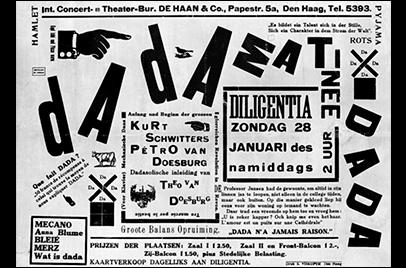
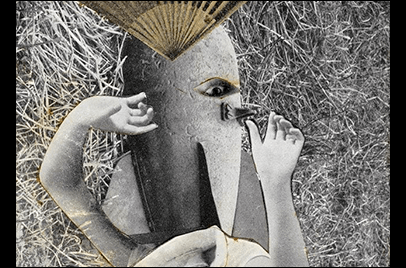
Unlike other movements, Dadaism had no set program or rules. Its adherents strove for freedom in everything and from everything, and recognized no authority.
In 1922, interest in Dadaism began to wane. And in 1924, it was even claimed that Dada had been overtaken by Surrealism. But in 2016, Dada's centenary was celebrated with great fanfare around the world, suggesting that the style hasn't died out; it lives on to this day, finding application in graphic design.
The philosophy of Dadaism is one of complete artistic freedom, and its tenets challenge established cultural standards. Works executed in the Dada style evoke not only surprise and awe, but also other emotions—from excitement and laughter to confusion and anger.
The main features of the Dada style were and remain:
irrationality;
denial of recognized canons in art;
cynicism;
disappointment;
lack of system.
The style, which can be characterized as a mockery of the old order and public opinion, is suitable for use in creative advertising campaigns for youth clothing brands, the creation of a visual image for startups, or event design, etc.
Dada is characterized by the use of typography, with capital and small letters in different font styles and colors, as well as photomontage. By combining images in this style, people can "read" a story even without text. Dadaism also utilizes a lot of white space, and images in compositions can be arranged in a variety of ways: one above the other, horizontally, or diagonally.
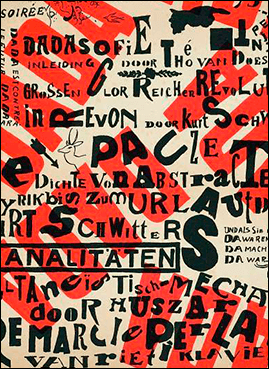
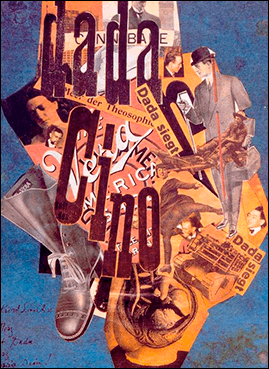
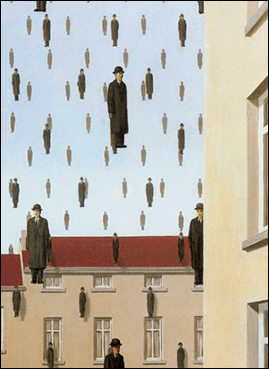
Dadaist ideas should be used cautiously in design, considering the target audience. An older, more conservative audience is unlikely to respond favorably to such designs, unlike the more progressive younger generation. To avoid the use of Dada elements in graphic design from appearing kitsch, it's best to entrust the work to skilled hands.
Looking through the portfolios of individual freelancers and design studios, one can see that Dadaism continues to influence contemporary creative professionals.
In 2020, many designers are embracing collage. They believe that this fragmented technique opens up new scenes and unexpected relationships between graphic elements. Such collages are perfect for creating editorial illustrations, posters, and book covers. They often feature abstract images as well as everyday objects.

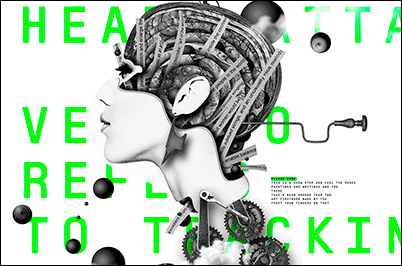
Designers blend images seemingly from different universes (for example, photographs and illustrations). However, the images are left with jagged edges and white outlines, resulting from the quick and careless cutting and pasting. The effect is to create so-called asynchronous beauty by uniting disparate elements into a single composition.
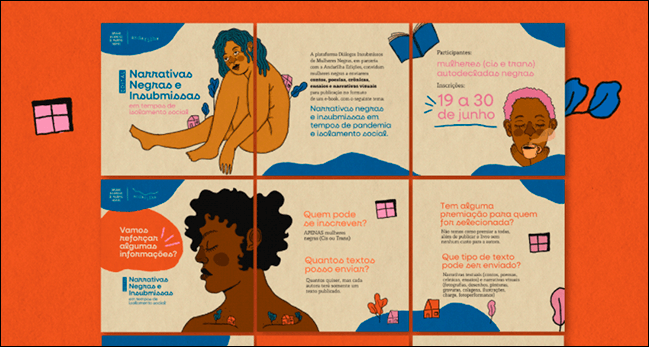
Modern Dada - style logos are signature designs with a touch of irony and absurdity. This approach is ideal if you want to emphasize your brand's individuality in a bold and unusual way.
Whether or not to choose Dadaism for yourcorporate identitydepends on the specifics and goals of your business. To enhance brand recognition, Dada-inspired logos can be featured on business cards and websites of art galleries, beauty salons, coffee shops, and restaurants.
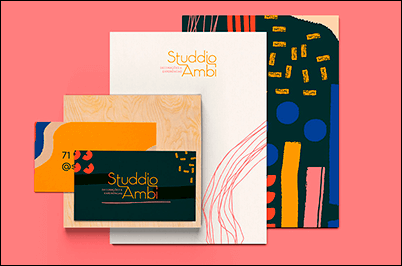
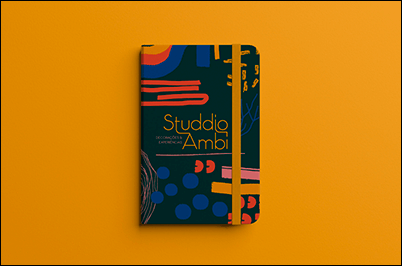
Dada-style identities are also printed on company employee clothing, souvenirs, etc.
Today, Dadaist ideas are reflected in the design of modern packaging for a wide variety of products.
For example, original abstract images can decorate the covers of music discs, packaging for shaving accessories for men and cosmetic sets for women.
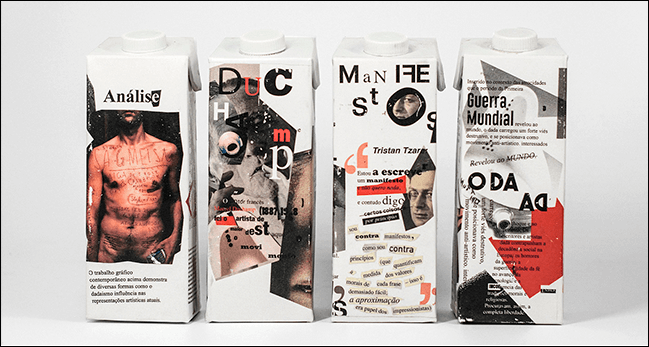
The Dada style inspires many designers to create expressive and striking packaging designs for food products (hot sauces, snacks, chocolate, ice cream, protein shakes).
Compared to product packaging, Dadaist influences inwebsite and social media design are still less common. However, some companies commission Dada-style designs for both traditional website pages and landing pages.
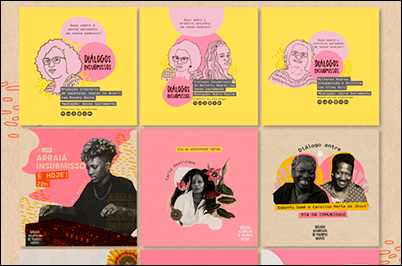

Interestingly, individual design elements can be completely incompatible with one another. For example, mismatched elements are combined in the cover images of the OtomPotom blog for German entrepreneurs. This is done to illustrate the abstract themes of the site's content.
In Ukraine and neighboring countries, Dadaism is not as widely known as in its homeland. One of the few echoes of this artistic movement is the "Nichovoki" group, which existed in Soviet Russia from 1920 to 1922.
Another example concerns Kazimir Malevich's world-famous painting "Black Square." It turns out that this work's roots lie in the innovative world of Dadaist theater, where it originated as a stage set.
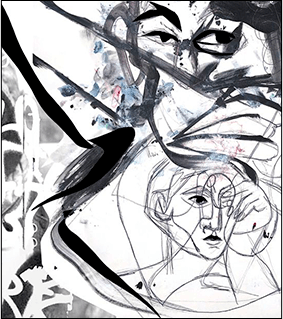
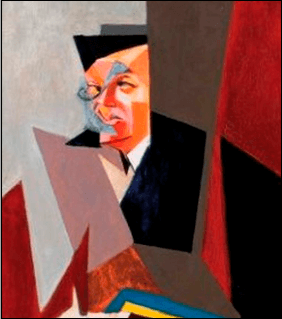
The largely conservative Ukrainian public is not yet able to appreciate the ideas of Dada due to their specificity and avant-garde nature, unlike more progressive European countries.
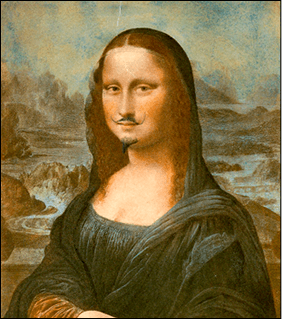
However, some Ukrainian designers are inspired by Dadaist ideas. This is evident in various works, such as the Mona Lisa with a painted-on mustache and others, created for advertising purposes.
In addition to poetry and prayer-like songs, Dadaists created sculptures, paintings, and posters. The most common form of art was collage. As this movement spread across Europe, three schools of Dada poster art emerged:
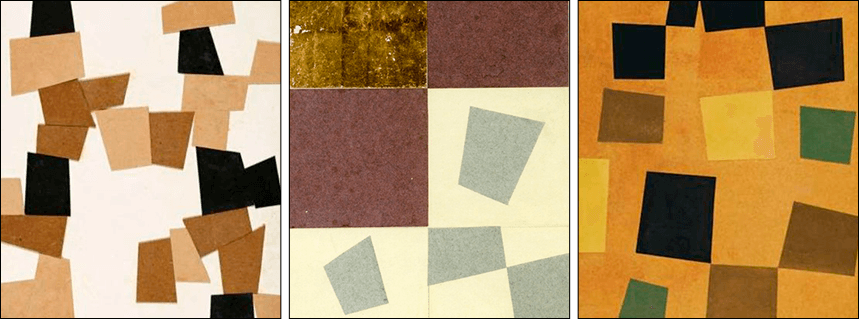
Zurich "Random" Collage .In Zurich, Dada enthusiasts emphasized the random combination of elements when creating collages. In visual art, this was reflected in Hans Arp's random scattering of colored paper rectangles onto a sheet of cardboard and gluing them in place.
Berlin Manifestation Collage .It can be described as multi-component and visually rich, with a distinctly political, protest-driven tone. Berlin collages often feature fragments of photographs, and the artists themselves call themselves "photomontage artists," thus abstracting from the image of creators and emphasizing their resemblance to industrial workers.
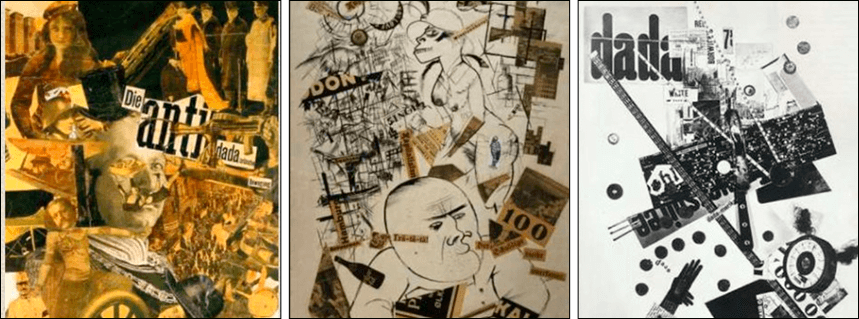
Cologne-Hanoverian Poetic Collage .In the works of Max Ernst (Cologne) and Kurt Schwitters (Hannover), collage is imbued with the qualities of poetry.
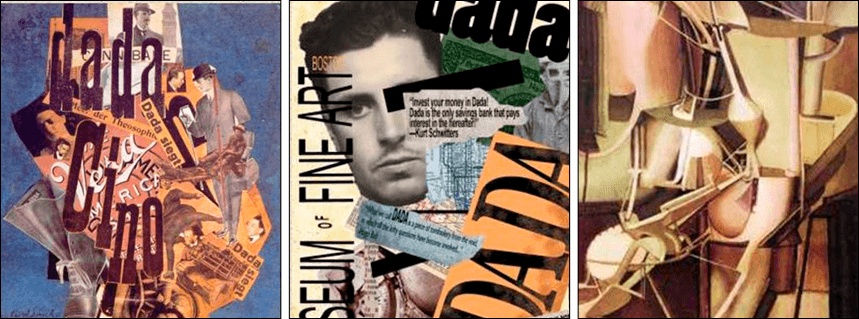
Dadaist ideas also reached America. In New York, the artist Marcel Duchamp was at the forefront of this movement. Along with his colleagues, he helped found an association aimed at developing and recognizing contemporary art in the United States and paved the way for the establishment of the Museum of Modern Art in New York.
Today, both adherents of contemporary Neo-Daism and artists faithful to classical Dadaism are active around the world. Among the latter is Irish artist Lola Dupré, who hand-creates collages from cut-up photographs, reconstructing the image anew.
Speaking of commercial work, it's worth mentioning the collages for the Carven SS 2014 advertising campaign, created without scissors and glue, using Photoshop and Lightroom.
The key thing to remember when working with the Dada styleisnot to overdo the absurd. Therefore, it's crucial to find a designer with a skilled hand. This can be achieved by:
Freelancing . But the process can be time-consuming, and you won't have any legal protection, as almost all freelancers work without a contract. Design prices here start at 10 $ for packaging, 30 $ for a logo, and 50 $ for a website.
In a design studio . Design development in a specialized company will cost you from $20 for printing, from $130 for a corporate identity, and from $150 for a logo.
In both cases, the exact price is determined based on the scope and timeframe of the work. To clarify any details you may have at WeLoveBrands, please call or chat with us online.